|
|
|
|
BK Investment Grade 8
Quarterly Report | 31st March 2026
|
|
The final NAV and distribution of the BK Investment Grade 8 (USD / EURO) as of 31 March 2026 is:
|
| USD Class |
|
EURO Class |
NAV 107.25%
|
|
NAV 109.85%
|
Distribution 1.50%
|
|
Distribution 1.50%
|
Payments for the Euro and Dollar class will be around April 22nd, 2026.
|
As part of our ongoing efforts to enhance communication with investors, the Crystal Fund newsletter—previously distributed exclusively via email—is now also available as a PDF. You can access the latest edition here.
|
|
|
|
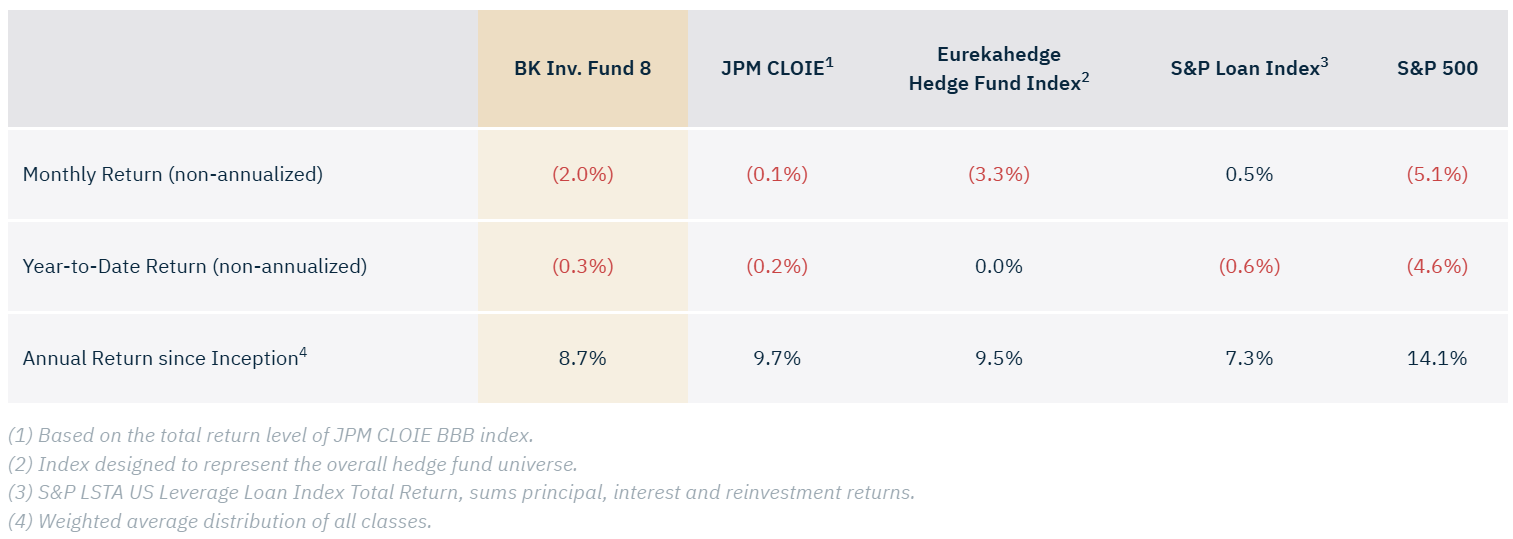
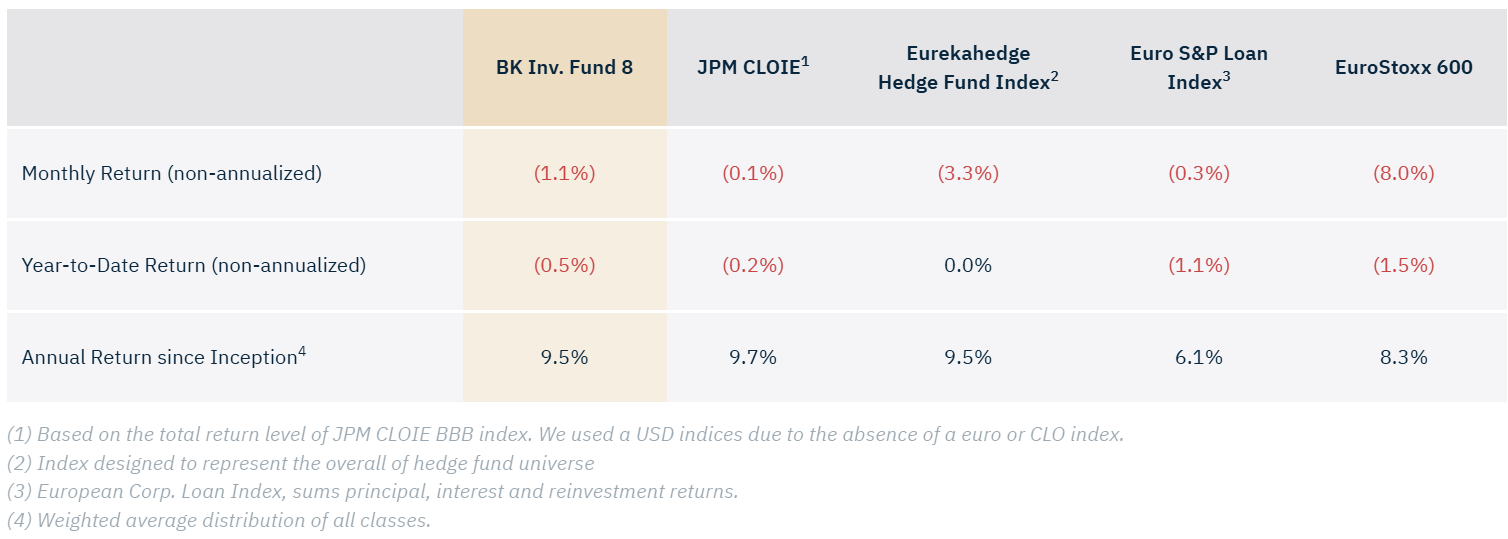
BK Opportunities Fund-8 final net performances
as of 31st March 2026
|
| Monthly1 |
-2.0% |
|
Monthly1 |
-1.1% |
| Year-to-Date1 |
-0.3% |
|
Year-to-Date1 |
-0.5% |
| Annual Return3 |
+8.7% |
|
Annual Return3 |
+9.5% |
|
|
|
|
|
16.0% |
|
|
+23.3% |
|
|
+25.8% |
|
|
3 - Weighted average distribution of all classes.
|
|
|
|
Fund and Market Performances as of 31st March 2026
|
USD
|
|
EUR
|
|
|
|
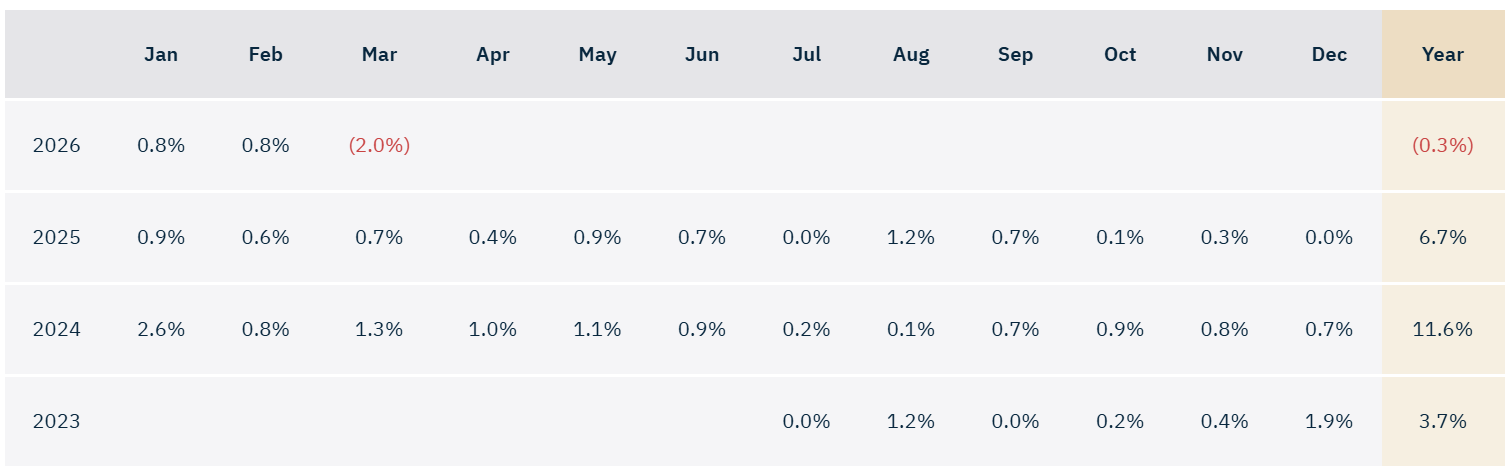
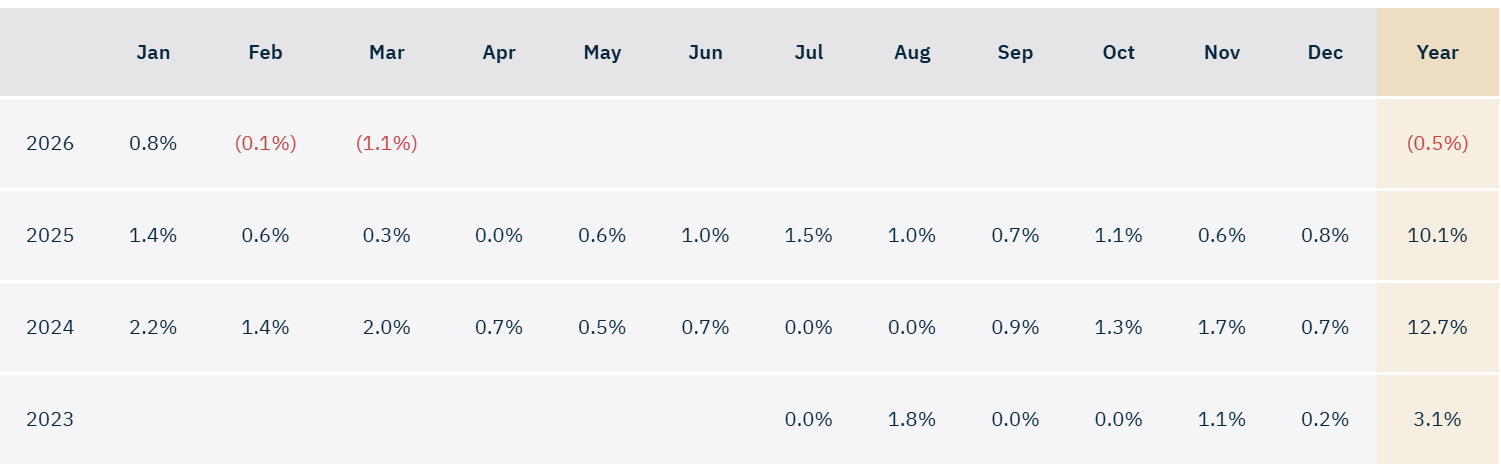
Monthly Performances
|
USD Performances
|
|
EUR Performances
|
|
|
|
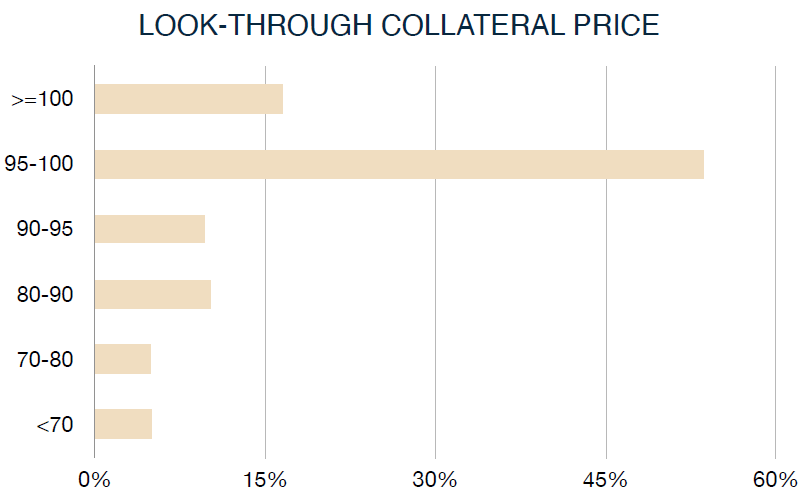
Look through Fund's Statistics
|
|
|
| Industry |
% of Portfolio |
| Healthcare & Pharmaceuticals |
10.9% |
| Services: Business |
9.6% |
| High Tech Industries |
9.5% |
| Banking, Finance, Insurance & Real Estate |
7.3% |
| Chemicals, Plastics & Rubber |
5.6% |
| Hotel & Leisure |
4.5% |
| Construction & Building |
4.5% |
| Telecommunications |
4.4% |
| Capital Equipment |
3.9% |
| Beverage, Food & Tabaco |
3.8% |
|
| Issuer |
% of Portfolio |
| Ineos |
1.6% |
| Liberty Global |
1.1% |
| Vmed O2 UK |
0.7% |
| 3I Group |
0.6% |
| Kantar Global |
0.5% |
| Altice NV |
0.5% |
| Clarios Int |
0.5% |
| Lorca Jvco |
0.5% |
| Froneri Lux |
0.4% |
| Nouryon Limited |
0.4% |
|
|
|
|
|
|
Market Commentary & Portfolio Overview
|
|
The US economy is holding up well, powered by tax cuts and AI investment, though the job market is cooling. Corporate earnings continue to impress with a sixth straight quarter of double-digit growth — but Tech is doing most of the heavy lifting. In leveraged loans, default rates are creeping higher and Q1 returns were the weakest since 2020; software is the most troubled sector. CLO issuance is expected to ease from last year's records but remain strong, boosted by growing ETF demand. Key concerns: geopolitical risk, software sector stress, and private credit redemption pressures.
|
|
|
|
|
|
|
The Economy
|
The US remains the global frontrunner with 2026 GDP growth projected at 2.4%, as the "One Big Beautiful Bill Act" tax cuts offset tariff drags and cooling job gains. However, the Federal Reserve’s path remains constrained; persistent AI-related capex and rising energy costs, alongside inflationary trade policies, leave little room for aggressive rate cuts.
|
|
Conversely, the Eurozone’s early 2026 recovery has been clouded by escalating Middle East conflict, with oil nearing $90/bbl and gas prices spiking. Consequently, consensus GDP has been revised down to 0.8–1.3%. This regional weakness is further exacerbated by a sharp divergence between a resilient Spain (1.8%) and a stagnant Franco-German core (0.9%).
|
|
|
|
|
|
Corporate Markets
|
The U.S. corporate sector continues its robust expansion, with Q1 2026 earnings projected to grow 13.2%—the sixth consecutive quarter of double-digit gains. Profit margins remain high at 13.2%, yet growth is heavily concentrated: while tech is surging at 23.7%, the rest of the S&P 500 averages a more modest 5%. Overall, U.S. corporate profits have reached a record $3.41 trillion, up nearly 11% year-over-year.
|
|
In contrast, Eurozone earnings fell 1.1% in Q4 2025, their weakest performance in nearly two years. This underscores a fragile market rally lacking fundamental earnings support, with performance sharply split between rallying energy giants and struggling luxury and tech leaders. Despite these headwinds, European credit remains stable; inflation has eroded real debt values, and a minimal 1.5% exposure to private credit limits systemic risk compared to the U.S. market.
|
|
|
|
Corporate Loans
|
The Federal Reserve has guided interest rates toward a 3.50–3.75% neutral range, stabilizing corporate investment and reviving the IPO and M&A pipelines. While overall credit quality remains solid, a "two-speed" consumer landscape has emerged: higher-income households continue to spend freely while lower-income cohorts pull back.
|
|
In the Eurozone, the credit environment is more constrained following an unexpected tightening of bank lending standards in Germany and France. Despite this, corporate loan demand is rising for working capital and refinancing, particularly in Germany and Italy. This tension is accelerating a shift from bank loans to bond markets, signaling a broader re-leveraging phase as regional capital expenditure begins to pick up.
|
|
|
|
CLO Market
|
The U.S. loan market faces increasing pressure, with the trailing 12-month payment default rate at 1.44% and the LME-inclusive dual-track rate at 3.48%. Geopolitical risks and tightening credit remain key concerns, especially in the $250bn software sector, which stands as the market's largest but most out-of-favour segment.
|
|
Europe shows more resilience with a lower 1.1% default rate, though speculative-grade defaults are forecast to rise toward 3.25% by late 2026. While 2025 saw record gross issuance, most was driven by refinancing rather than new capital. In both regions, a sustained M&A recovery is now the essential prerequisite for fresh issuance, amid ongoing concerns over private credit redemption pressures and sharp price drops for downgraded credits.
|
|
|
|
|
|
|
BK Investment Grade Fund 8: Portfolio Overview
|
We have built a robust portfolio of BBB CLO tranches with USD (56%) and Euro (44%) positions. The portfolio is diversified by profile (the style of the CLO manager), vintage, and duration. We have participated in both new issues and the secondary markets, but have been more active in the latter over the recent months.
|
The priority has been on selecting our reinvestments given current market conditions and a spread-tightening environment; we receive both interest (from coupon payments) and principal (from transactions being restructured, more precisely, called resets). If a portion is kept for distribution, most of these proceeds are reinvested as we identify opportunities that fit our target return for BK Investment Grade-8. The objective is to maximise the expected returns while maintaining the same resistance levels. The portfolio is designed to benefit from a market softening but also resist more conservative scenarios. The fund distributes 1.5% for each USD and Euro class this quarter, bringing the total distribution to 16.0% since inception. Payments are being wired on or around 30th April 2026.
|
|
Since its inception, the USD portfolio has delivered 8.7% annually, and the Euro portfolio has delivered 9.5%, meeting our expectations. We believe the portfolio will continue to deliver strong performances as we maintain our trading discipline and strategy.
|
|
|
|
|
|
|
|
Fund’s Summary
|
| Currency |
USD and EUR |
| Fund’s Inception |
June 2023 |
| Distribution |
Quarterly |
| Investment Manager |
Oristan Ireland DAC |
| Administrator |
Apex Funds Services |
| Custodian |
CIBC Bank & Trust |
| Counsel |
Dillon Eustace |
| Auditor |
Deloitte |
| Bloomberg Page |
|
BKIG8AU KY <Eqty> (USD KY Feeder)
|
|
BKIG8AE KY <Eqty> (EUR KY Feeder)
|
|
BK8A1US LX <Eqty> (USD LX feeder)
|
|
BK8A1EU LX <Eqty> (EUR LX Feeder)
|
|
|
|
Portfolio Manager
Olivier Gozlan
|
|
|
|
|
|
|
|
|
|
This is not for distribution to, or use by, any person or entity in any jurisdiction where such distribution or use would be contrary to law or regulation. The information contained herein is for information only and does not constitute an offer regarding any product. The document has been prepared by Oristan Ireland DAC and the data have not been audited nor verified. Past performance cannot indicate future performance. There is no assurance that the investment objective will be achieved and investment results may vary.
|
|
|
|
|
|
|
|
|